



2026
CSIR-IICT · Hyderabad
Organic Synthesis & Catalysis LabWe design colourful molecules that catch light — and put it to work.
Our group makes new organic molecules, atom by atom, that absorb sunlight and indoor light. Those molecules end up in next-generation solar cells, drive greener chemical reactions, and glow to detect harmful substances.
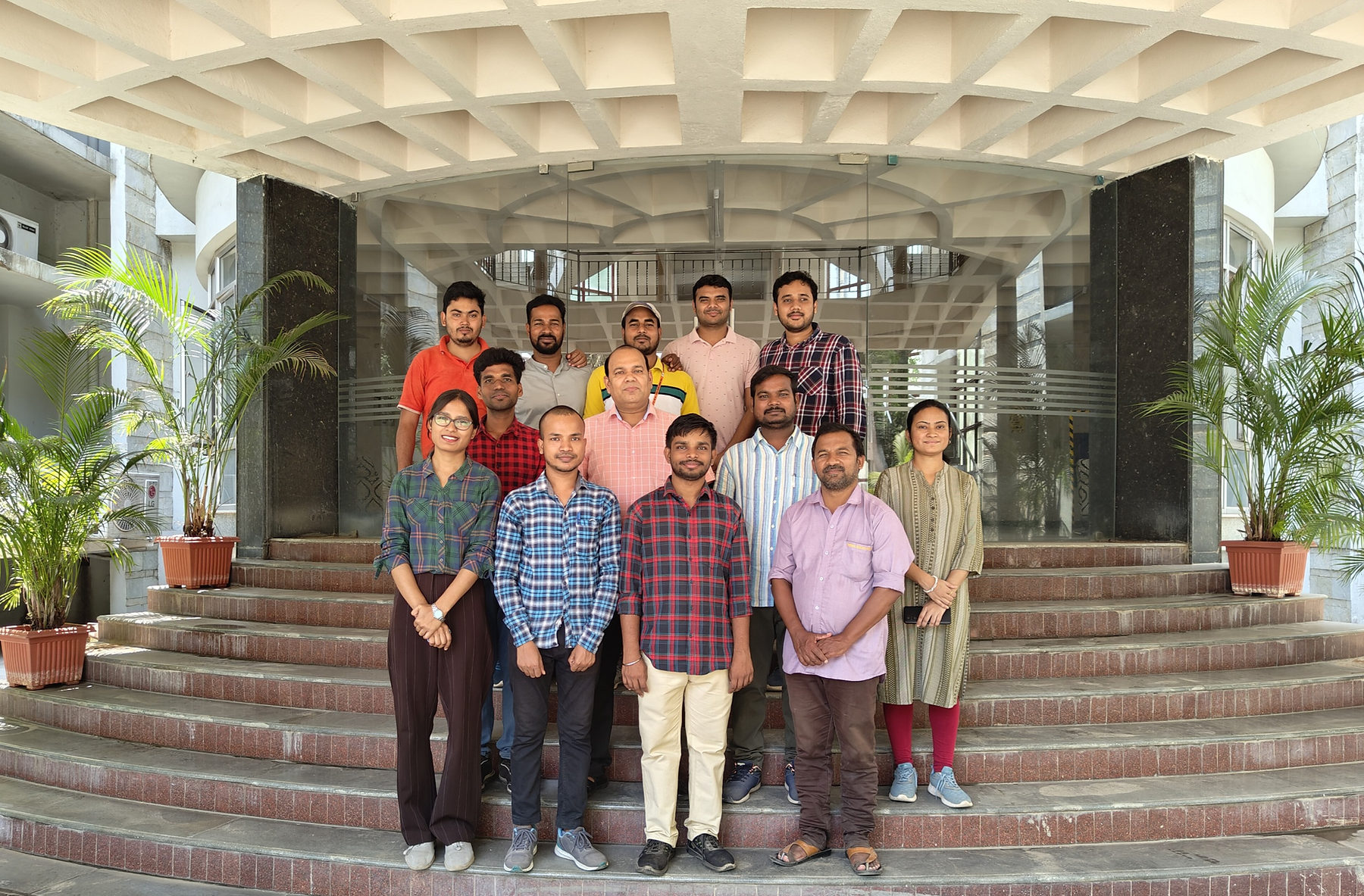
 Led byDr. Surya Prakash Singh, FRSCThe group at CSIR-IICT, Hyderabad
The idea, in plain words
Everything we do starts with light
You don't need a chemistry degree to follow our work. Here it is in three steps.
- 1
Light comes in
Sunlight — or the light from a lamp — is a mix of colours, and every colour carries a little packet of energy.
- 2
Our molecules catch it
We design molecules — chains of carbon rings — that absorb exactly the colours we choose. Swap one atom, and the colour they catch changes.
- 3
The energy does a job
Inside a solar cell it becomes electricity. In a flask it drives a cleaner chemical reaction. In a sensor it makes a glow that reveals a pollutant.
What we work on
Five projects, one toolbox
Each project uses the same skill — building molecules to order — for a different job.
Organic & indoor solar cells
We make dye molecules that soak up sunlight — or the light from a lamp — and turn it into electricity.
Why it mattersThin, light, colourful solar cells could power sensors, smart labels and gadgets indoors, without batteries.
Read morePerovskite solar cells & hole-transport materials
We make the thin "middle layer" that carries electric charge out of a new, very efficient kind of solar cell — and protects it.
Why it mattersPerovskite solar cells could become cheaper than silicon, but they need better, longer-lasting materials to reach rooftops.
Read moreLight-driven chemistry
We use visible light — even ordinary LEDs — to drive chemical reactions that normally need heat, harsh chemicals or rare metals.
Why it mattersMedicines, dyes and materials could be made in fewer steps, at room temperature, with less waste.
Read moreGlowing dyes & sensors
We make molecules that glow brightly — and switch their glow on or off when they meet something specific, like an explosive or a toxic metal.
Why it mattersCheap glowing sensors can spot pollutants or explosives, and help biologists see inside living cells.
Read moreNanohoops & molecular rings
We build tiny rings out of carbon — hoop-shaped molecules only a few billionths of a metre across.
Why it mattersBending a molecule into a ring changes how it handles light and charge, opening up new designs for electronics.
Read moreThe people
A group of 17 chemists — and 16 doctors who started here
PhD scholars, postdocs and project scientists from across India work in the lab. Our graduates now teach and research in India, South Korea, Poland and Taiwan, and work in industry.
Our work, counted
- Research papers
- 262
- Times cited
- 7,287
- h-index
- 44
- PhDs mentored
- 16
Paper and citation counts from OpenAlex, October 2026. Google Scholar usually reports higher numbers —see Scholar.

Principal investigator
Dr. Surya Prakash Singh, FRSC
Senior Principal Scientist (Scientist-F), CSIR-Indian Institute of Chemical Technology
Dr. Singh trained as a chemist at the University of Allahabad, spent five years in Japan at Nagoya, Osaka and NIMS Tsukuba, and has led his group at CSIR-IICT since 2011. He has published more than 250 research papers on light-harvesting molecules and has mentored 16 PhD graduates.
- 2025MRSI Medal
- 2024CRSI Bronze Medal
- 2021Fellow of the Royal Society of Chemistry (FRSC)
- 2017Newton Prize (team award)
Latest papers
Fresh from the lab
Updated automatically from OpenAlex every time the site is rebuilt.
2026
2026
2026
2026
News
What's new
A two-in-one layer for longer-lasting perovskite solar cells
Our new hole-transport material, published in Small, both carries charge and heals defects in perovskite solar cells.

Posters, questions and a great turnout at Samyukth 2025
Group members presented their latest work on solar-cell materials, catalysis and sensors at Samyukth 2025.
Dr. Singh receives the MRSI Medal
The Materials Research Society of India has recognised Dr. Singh's work on functional organic materials for energy.
Want to work with us?
We welcome PhD applicants, postdocs and industry partners who want new molecules for light, energy and sensing.